.jpg&w=3840&q=75)
D2C Fulfillment Is Broken - Your Tech Stack Is Why
OMS, WMS, and delivery intelligence are not software categories. They are the operating layer that decides whether your brand survives quick commerce - or gets commoditized by it.
Here is the uncomfortable truth: you can have the best product, the sharpest creatives, and a ROAS your growth team brags about at board meetings, and still bleed money because your fulfillment stack is a patchwork of disconnected systems that cannot talk to each other at 2 PM on a Friday.
Why Quick Commerce Demands a Different Fulfillment Infrastructure
Quick commerce in India is no longer a channel experiment. Blinkit, Zepto, and Swiggy Instamart collectively processed over 6 million orders a day in early 2025 (Redseer estimates, directional). Platforms like Myntra and Nykaa are now offering same-day windows. Your customer's default expectation in Tier 1 cities has shifted from "when will it ship?" to "can I get this in 60 minutes?"
The brands winning this game are not just the ones with good products. They are the ones whose operational infrastructure, specifically their OMS, WMS, and delivery intelligence layer, is built for speed. Let us break down what that actually means.
OMS in Quick Commerce: Real-Time Order Orchestration, Not Just Recording
What Separates a Legacy OMS from a Quick-Commerce-Ready One
A legacy Order Management System is built for one thing: recording that an order happened. Date, SKU, quantity, shipping address - logged and forgotten. That model worked when you had one warehouse, three SKUs, and same-week delivery expectations.
Modern D2C fulfillment across quick commerce requires something fundamentally different: an OMS that can route an order in real time based on live inventory, proximity to the customer, SLA window, and current dark store capacity. Not batch-processed. Not rule-based in 2019 logic. Real time.
For a brand operating across Delhi NCR, Mumbai, and Bengaluru through a network of dark stores, a single order can have 12 potential fulfillment paths at the moment it is placed. The right OMS evaluates all 12 in milliseconds and picks the one that fulfills the SLA at the lowest cost. The wrong one picks the first path in alphabetical order by warehouse name.
"Routing logic if the hidden margin lever. A 10% improvement in order allocation can move blended fulfilment cost by 15-20 rupees per shipment- at volume, that is a P&A line item"
The Technical Requirements for Multi-Node, Real-Time Order Routing
The technical requirements for a quick-commerce-ready OMS include: real-time inventory sync across nodes (not hourly batch), multi-node split order handling, dynamic SLA management by channel (30-min vs. 60-min vs. same-day), and exception alerting before the SLA breaches - not after.
WMS for Dark Stores: Built for Speed, Not Shelf Management
If the OMS is the brain, the Warehouse Management System is the nervous system of every dark store. And in hyperlocal delivery operations, a WMS failure does not mean a delay - it means a breach, a refund, and a one-star review.
Most D2C brands running their own fulfillment either use a retail WMS designed for large-format stores (too slow) or a makeshift spreadsheet/ERP setup (comically inadequate). Neither was built for the operational rhythm of a 600 sq ft dark store processing 300 orders a day with average picker-to-dispatch times under 4 minutes.
Four Capabilities Your Dark Store WMS Must Have
- Slotting intelligence: High-velocity SKUs need to be in shortest pick-path positions - and that slotting must update automatically as velocity changes, not quarterly during a physical reset.
- Batch picking: Picking one order at a time in a 300-order-a-day dark store is how you miss every SLA. The WMS must support wave and cluster picking.
- Live shrinkage tracking: Inventory discrepancies compound fast at dark store scale. A WMS that cycles-counts continuously rather than once a month is non-negotiable.
- FEFO enforcement: For perishables, pharma, or beauty with expiry windows, first-expired-first-out logic must be system-enforced, not operator-dependent.
The benchmark to hold your WMS against: can your picker achieve under 4 minutes from order release to handoff to delivery executive? If your current setup cannot answer that question with data, that is the diagnosis.
Delivery Intelligence: Cutting RTO and SLA Breaches Before They Happen
What a Delivery Intelligence Layer Actually Does
This is the layer most brands do not have at all - and it is where the sharpest operators are building serious competitive separation.
Delivery intelligence is not a tracking page. It is the system layer that handles: real-time route optimization for last-mile riders, dynamic capacity allocation across delivery zones, predictive exception management (identifying a likely late delivery 8 minutes before it becomes one), and RTO reduction through behavioral and address-quality signals.
How RTO Reduction Works as a Margin Lever
RTO (return to origin) - is a silent killer in Indian e-commerce. Industry estimates (Shipway, 2024) suggest RTO rates for fashion brands on open-web channels run 25 to 40%. Even for better-operated brands on quick commerce, undeliverable and refused deliveries create 6 to 12% leakage on contribution margin. A delivery intelligence layer that flags high-risk orders before dispatch - and triggers a pre-delivery confirmation nudge - can move that number meaningfully.
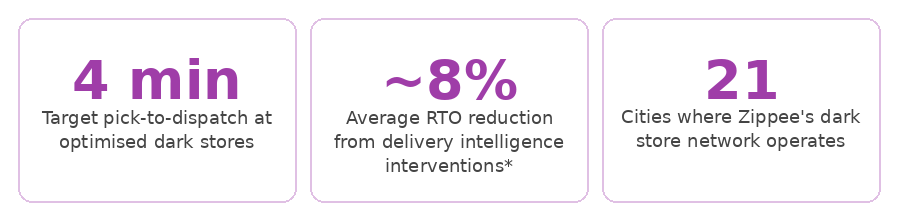
* Directional estimate based on Zippee operational data across brand cohort; individual results vary by category, order density, and address quality.
Build, Buy, or Partner: Choosing the Right Fulfillment Infrastructure Model
Every ops leader at a scaling D2C brand eventually faces this question. Here is the honest breakdown - not the vendor pitch version.
| Dimension | Build in-house | Buy point solutions | Integrated infra partner |
| Time to go live | 12-24 months | 3-6 months per tool | 4-8 weeks |
| OMS + WMS integration | Custom build required | API duct-tape; brittle | Native; pre-built |
| Dark store network access | None (build from scratch) | None | Day 1, 21 cities |
| Delivery intelligence | Possible, expensive | Limited; siloed data | Embedded; cross-brand signal |
| RTO reduction tooling | Rarely prioritized | Available, add-on cost | Built into delivery layer |
| CapEx commitment | High (tech + ops headcount) | Medium (licensing + integration) | Variable, scales with volume |
| Right for | Funded brands >500Cr GMV with dedicated tech org | Brands with existing infra, patching gaps | Brands scaling from 50Cr to 500Cr+ who want speed |
The build-it-yourself argument sounds appealing when someone in a board meeting says "we need proprietary logistics." It is rarely a good idea before 500 crore in GMV. The ongoing engineering cost, the integration debt, and the opportunity cost of your tech team not working on product are all underestimated by roughly 3x in every business case we have seen.
Five Questions to Audit Your Current Fulfillment Stack
If you already have some version of these systems, here are the five questions to pressure-test your setup before quick commerce volumes expose the gaps:
- Is inventory sync real-time or batch? If your OMS pulls inventory every 15 minutes, you are overselling and underselling simultaneously. At 300 orders a day, this creates 20 to 30 reconciliation exceptions weekly.
- Can your WMS report average pick time by shift? If you cannot answer this question in under 60 seconds, your WMS is a record-keeper, not an operational tool.
- What is your dark store SLA breach rate, and who owns it? If the answer is "we check at end of day" you have a process problem layered on a tech problem.
- Is your RTO data feeding back into dispatch decisions? If refusal and undeliverable data lives only in a finance reconciliation report, you are not using it.
- How long does it take to onboard a new dark store node? Best-in-class is under two weeks. If your answer is "it depends on IT," that is a ceiling on your expansion velocity.
How Zippee Functions as Quick Commerce Infrastructure for D2C Brands
What the Zippee Stack Includes
Zippee is not a courier. We are the quick commerce logistics infrastructure layer for D2C brands - the operating system that sits beneath your storefront and above the last-mile rider. That means: a pre-built network of dark stores across 21 cities, a proprietary OMS with real-time multi-node routing, a WMS purpose-built for dark store throughput, and a delivery intelligence layer with RTO-reduction logic trained on cross-brand signal data.
Brands like HealthKart, Epigamia, Supertails, and Clinikally run 30-min and same-day delivery through Zippee today - not because they built their own fulfillment infrastructure, but because they plugged into ours.
Integration Timeline and Day-One Capabilities
The integration timeline is 4 to 8 weeks for most brands. You get the dark store footprint, the tech stack, and the operational playbook on day one.
The honest version of our pitch is this: the tech stack described in this piece - a smart OMS, a dark-store-grade WMS, and a delivery intelligence layer - is expensive and slow to build. The brands that get to market in 2026 will be the ones that do not try to build it themselves.
Quick commerce logistics in India is moving toward a model where fulfillment speed and cost are infrastructure, not competitive advantages. The competitive advantage is what you do with the customer once they receive their order in 40 minutes. Your job is brand-building. Ours is making sure the box arrives.
The Operational Foundation D2C Brands Need to Compete in 2026 and Beyond
The D2C brands that will be well-positioned in 2028 are building now - not product lines or ad budgets, but the operational infrastructure to support the demand those investments generate. An OMS that routes intelligently, a WMS that processes at dark-store speed, and a delivery intelligence layer that cuts RTO and breach rates are not optional upgrades. They are the table stakes for competing in a quick commerce environment where your customer's patience window is measured in minutes, not days.
Zippee exists to be that infrastructure layer - so you do not have to build it yourself, staff it yourself, or wait 18 months to find out if your architecture choices were right.
Turn your fulfilment into competitive advantage
Join 100+ D2C brands and marketplaces operating 30-min, 60-min, and same day delivery through Zippee's infrastructure across 21 Indian cities.


.jpg&w=256&q=75)
.jpg&w=256&q=75)


.jpg&w=256&q=75)


