Quick Commerce Inventory Positioning Guide
The fastest delivery infrastructure in the world cannot save you if the product is in the wrong city.
Speed is downstream of placement. Most brands optimizing for quick commerce logistics in India are solving the wrong problem first.
They invest in carrier SLAs, last-mile routing, and packaging. All of it matters. But none of it compensates for a dark store in Bengaluru holding six weeks of stock for a product that moves exclusively in Delhi NCR during winters. The fill rate dies. The promise of same-day delivery dies with it. And the RTO rate quietly climbs because you start substituting, delaying, or canceling.
This post is about what actually determines whether quick commerce works for a D2C brand at scale: inventory positioning. Not as a warehouse concept, but as a predictive, city-level, SKU-level science.
Why Traditional Inventory Logic Fails in a Quick Commerce Model
The shift from centralized fulfillment to hyperlocal dark store constraints
In conventional D2C fulfillment, you hold inventory centrally and ship nationally. Your safety stock calculations are simple: average daily demand plus a buffer. You optimize for cost-per-unit-shipped and replenishment lead time from your 3PL.
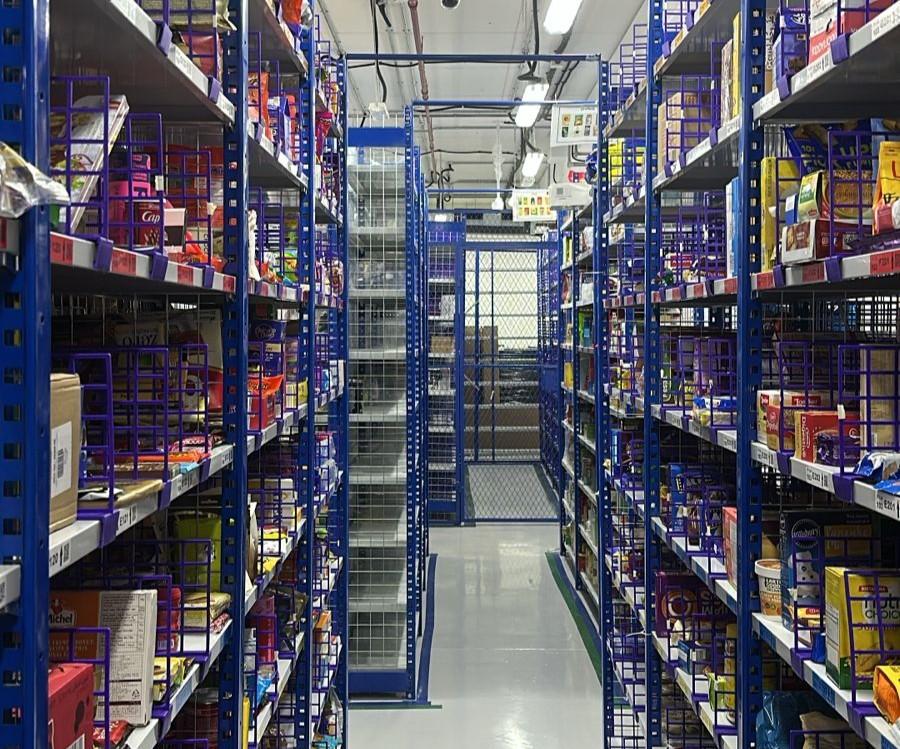
Quick commerce inverts every assumption. You are no longer shipping from one hub to anywhere in India over 2-5 days. You are promising delivery within 30-60 minutes from a dark store that is roughly 2,000-4,000 sq. ft., holds perhaps 500-800 active SKUs, and serves a radius of 3-5 km. That store cannot hold everything. It should not hold everything. And what it holds must be right, because there is no fallback SKU transfer from another node in time.
Why SKU selection precision outweighs selection volume
The constraint is no longer cost or carrier. It is physical space versus SKU velocity, matched at hyperlocal resolution.
A dark store that stocks the wrong 800 SKUs will underperform one that stocks the right 400. Density of selection means nothing without precision of selection.
The Four Variables That Actually Drive Accurate Inventory Positioning
Inventory positioning for quick commerce is a function of four variables, and most brands are only using two of them.
Hyperlocal demand signals at the pin code level
Pin code-level order history is the foundation. But it needs to be disaggregated further - by day of week, time of day, and seasonal trigger. A protein supplement brand might see 70% of its Bengaluru orders come from two pincodes in Koramangala and Indiranagar. Within those, weekend mornings drive disproportionate volume. That is the positioning signal.
SKU perishability and shelf-life thresholds
Brands like Epigamia (yogurt, dairy) and similar fresh-food players cannot use the same positioning logic as a skincare brand. Perishable SKUs require tighter demand confidence before you push them into a dark store node. Overstocking a slow-moving perishable at a node is not a markdown problem; it is a write-off.
Order clustering and basket co-occurrence behavior
If SKU A and SKU B are ordered together 60% of the time, separating them across nodes is a fill rate disaster. Basket analysis at the node level changes how you think about which SKUs co-exist in the same dark store. This is where hyperlocal D2C fulfillment strategy diverges sharply from general ecommerce logic.
Replenishment latency from your mother warehouse
If your nearest replenishment hub is 90 minutes from the dark store, your safety stock math changes entirely. A SKU with a 2-hour replenishment window can carry lower buffer stock than one with a 24-hour window. Brands that ignore this end up either over-stocking (wasted space, working capital trapped) or stocking out mid-day.
A Tiered Framework for Assigning SKUs to Dark Store Nodes
Not every SKU belongs at every node. A workable framework is to classify SKUs into three tiers based on velocity, margin, and demand predictability -- and match each tier to a positioning strategy.
| TIER | SKU TYPE | NODE COVERAGE | SAFETY STOCK LOGIC | RISK |
| Core | Top 20% SKUs driving 60-70% of volume | All active nodes in the city | High buffer; replenish daily | Low |
| Zonal | Mid-velocity, city-specific movers | 2-3 nodes with highest demand signal | Moderate buffer; trigger-based replenishment | Medium |
| Long-tail | Low velocity, niche, seasonal, new launches | 1 node or on-demand from mother hub | Minimal or virtual stock; fulfilled from hub | High if misplaced |
| Perishable | Fresh, chilled, short shelf-life | Demand-confidence gated; city-specific | Just-in-time; daily write-off reconciliation | Dynamic |
Framework based on operational benchmarks from Zippee's dark store network. Numbers are directional.
The practical implication: a brand with 1,200 active SKUs should typically be positioning roughly 150-250 at any given dark store, not all 1,200. The selection changes by city, by neighborhood, and by season. Static SKU lists are an artifact of traditional 3PL thinking.
How Inventory Mis-Positioning Silently Drives Up RTO Rates
There is a persistent belief in D2C operations that RTO reduction is a logistics problem - better address verification, NDR workflows, delivery attempts. These matter. But a non-trivial share of RTOs in quick commerce trace back to inventory mis-positioning.
When a brand cannot fulfill the exact SKU ordered within the promised window, the fallback options are all bad: cancel and refund, substitute without consent, or delay and lose the customer's trust anyway. Each of these outcomes creates a negative signal in repurchase probability. In categories where trial-to-repeat is the key business metric -- health supplements, specialty food, skincare - a single broken delivery promise has outsized LTV impact.
Directionally, brands that get node-level inventory positioning right tend to see fill rates above 94-96%, versus 82-88% for those operating with centralized inventory logic pushed into quick commerce without adjustment. Those 10+ percentage points are not a delivery metric. They are a revenue metric. (These are directional estimates from observed operational patterns; your category and SKU mix will vary.)
For more on how fulfillment decisions compound into customer lifetime value, see Zippee's blog.
Why a Single National Reorder Policy Breaks Across India's Metro Markets
India's metro markets do not behave like one market. Delhi NCR skews toward high-AOV health and wellness orders, with strong afternoon and evening demand windows. Mumbai concentrates volume in specific micro-markets - Bandra, Andheri, Lower Parel, with more erratic intraday patterns. Bengaluru's tech corridor drives repeat purchase behavior at higher frequency than most other cities.
A brand operating across 8-10 cities with a single national reorder policy for each SKU is effectively flying blind in half of those markets. The SKU that is a core mover in Hyderabad might be a long-tail SKU in Pune, and vice versa. When the same safety stock formula is applied uniformly, you will simultaneously over-stock in low-demand nodes and stock out in high-demand ones.
This is why same-day delivery at scale requires city-level inventory intelligence, not just city-level logistics infrastructure. The two are related but not the same.
How Zippee's Dark Store Network Executes Node-Level Inventory Intelligence
Zippee is not a delivery vendor that happens to have dark stores. The network of dark stores across 21 cities, including Delhi NCR, Mumbai, Bengaluru, and Hyderabad, is the infrastructure layer on top of which inventory positioning decisions are made and executed.
What this means in practice: brands working with Zippee get node-level demand visibility that most 3PLs cannot provide because most 3PLs are not operating hyperlocal fulfillment infrastructure at this resolution. The data that feeds into SKU-to-node assignment- pincode demand signals, basket co-occurrence, replenishment latency by node, is a byproduct of running the network, not a consulting add-on.
Marketplaces like HealthKart and Myntra, and brands like Supertails and Clinikally, use Zippee not because they needed another courier. They needed a fulfillment partner who could absorb the complexity of quick commerce logistics in India at the inventory layer, not just the last-mile layer. There is a significant difference.
For a closer look at how dark store economics work in the Indian context, the Zippee blog covers the unit economics in more detail.
Inventory Positioning as a Revenue Strategy, Not a Supply Chain Function
Quick commerce in India is moving past the phase where the primary differentiator is delivery speed. Most credible operators can now promise 30-60 minute windows in Tier 1 cities. The next competitive gap is being opened at the inventory layer.
Brands that treat inventory positioning as a supply chain back-office function, something to be handled by ops teams after the commercial decisions are made, will find themselves over-invested in delivery speed for a product that is not at the right node. Brands that treat it as a strategic capability, with city-level SKU intelligence and node-specific positioning logic, will convert that fulfillment capability into fill rate, repeat purchase, and margin.
Zippee is built to be that infrastructure layer. Not a delivery vendor. Not a 3PL with a quick commerce pitch deck. Infrastructure, the kind that makes your inventory positioning decisions actually executable at the node level, across 21 cities, at the speed quick commerce demands.
If you're ready to turn your fulfillment into a competitive advantage, join our waitlist.


.jpg&w=256&q=75)
.jpg&w=256&q=75)


.jpg&w=256&q=75)


